Abstract
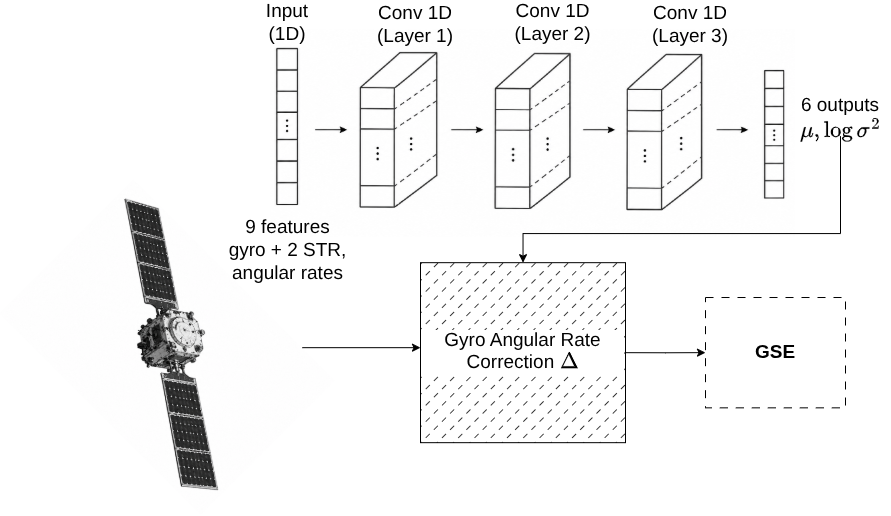
This work investigates uncertainty decomposition and explainability in a deep learning-based framework for gyroscope bias correction. A 1-D Convolutional Neural Network is trained to predict residual angular rate corrections from multi-sensor inputs, including gyroscope and star tracker measurements. The bias corrections are sent to a flight-representative Gyro-Stellar Estimator. The network produces both mean corrections and input-dependent (heteroscedastic) aleatoric uncertainty, while epistemic uncertainty is estimated via an ensemble of independently trained models. The proposed approach is trained under nominal conditions and evaluated in both nominal and structured perturbations that include additive and temporally correlated noise. Gradient-based attribution methods are applied to both the correction and uncertainty outputs, enabling a decomposition of the evidence that drives state updates and uncertainty estimates. By aggregating attribution patterns across rotational axes and regimes, we reveal axis-specific behaviors and characterize how structured perturbations influence the collaboration between aleatoric and epistemic uncertainty. Uncertainty analysis shows that aleatoric uncertainty increases with perturbation intensity, but the distributions overlap and the calibration is not consistent across regimes. On the other hand, epistemic uncertainty gives a clear signal that gets clearer as the distributional shift happens, showing that the models disagree more. These results show that aleatoric and epistemic uncertainty work well together and that epistemic uncertainty is better at distinguishing between nominal and perturbed operating conditions. The results provide insight into the behavior of hybrid learning-based state estimation components and motivate the use of uncertainty for downstream monitoring and fault detection.
Contributions
- Explaining both correction and uncertainty. We apply attribution analysis to a heteroscedastic residual-correction model, comparing the input structures that drive the predicted correction μ and the predicted uncertainty log σ2. This extends attribution beyond deterministic prediction outputs toward uncertainty-aware learned components.
- Understanding uncertainty under sensor perturbations. We evaluate uncertainty behavior using calibration, entropy, and ensemble-based epistemic separation. This allows us to study not only whether the model is accurate, but also when its confidence becomes unreliable or sensitive to distribution shift.
- Realistic structured OOD evaluation. We test the learned correction model under temporally structured perturbations designed to reflect realistic sensor degradation modes, including correlated noise, vibration, drift, dropouts, and combined effects. This provides a more informative stress test than standard i.i.d. noise perturbations.
Key Insights
- UQ and attribution are complementary: uncertainty indicates when the learned correction becomes less reliable, while attribution helps explain which sensor channels and time regions drive the correction and uncertainty outputs.
- OOD uncertainty can grow without complete feature redistribution: structured perturbations can increase uncertainty even when attribution patterns remain relatively stable.
- Uncertainty response is not uniform: aleatoric and epistemic components respond differently depending on perturbation type, intensity, and axis.
- Nominal accuracy is not enough: learned residual correction can substantially reduce gyro error, but trustworthy integration requires understanding behavior under sensor degradation and distribution shift.
Results
We summarize the results along three questions:
- Does the learned correction improve estimation input quality?
- Does uncertainty reflect reliability under perturbations?
- Do attribution maps explain which inputs drive correction and uncertainty?
Residual Correction
The learned model substantially reduces gyro-residual error compared with both the raw gyro signal and a naive correction baseline. Across residual magnitude statistics, the CNN correction produces lower mean error, RMSE, median error, and high-percentile error. This shows that the learned component can improve the input quality for gyro-stellar attitude estimation under nominal conditions.
Takeaway: learned residual correction provides a strong nominal performance gain, reducing the mean residual magnitude by approximately 90% compared with the raw gyro signal.
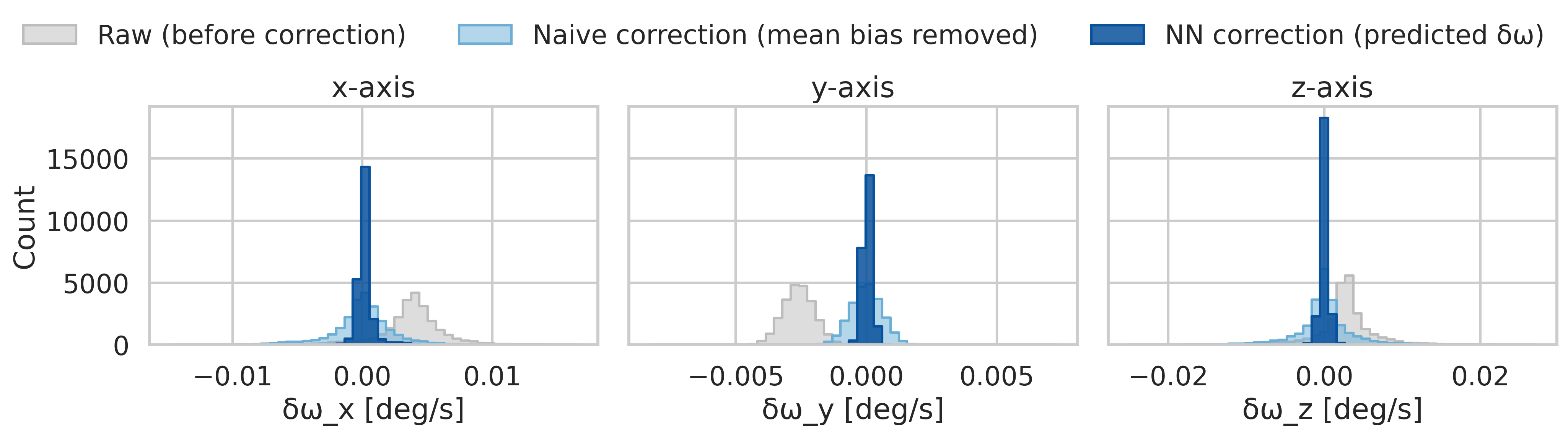
Per-axis comparison of gyro-residual errors for the raw gyro signal, naive baseline, and learned CNN correction.
| Metric | Raw | Naive | CNN | Improvement (CNN vs. Raw) |
Improvement (CNN vs. Naive) |
|---|---|---|---|---|---|
| Mean | 6.61e-3 | 3.41e-3 | 6.22e-4 | 90.6% | 81.8% |
| RMSE | 7.33e-3 | 4.95e-3 | 8.44e-4 | 88.5% | 82.9% |
| Median | 5.91e-3 | 2.20e-3 | 4.62e-4 | 92.2% | 79% |
| p95 | 1.21e-2 | 1.03e-2 | 1.66e-3 | 86.2% | 83.8% |
Uncertainty Behavior
We analyze uncertainty through three complementary diagnostics: predicted aleatoric variance, ensemble-based epistemic uncertainty, and z-score behavior. Together, these show how the model’s reliability changes from nominal ID conditions to structured OOD perturbations.
Under OOD perturbations, uncertainty generally increases, but the response is not uniform across perturbation type, intensity, or axis. The z-score plots further show where normalized residuals become inconsistent with the predicted uncertainty, revealing temporal and axis-specific reliability changes.
Takeaway: uncertainty is informative for reliability assessment, but aleatoric variance, epistemic disagreement, and z-score behavior should be interpreted jointly.
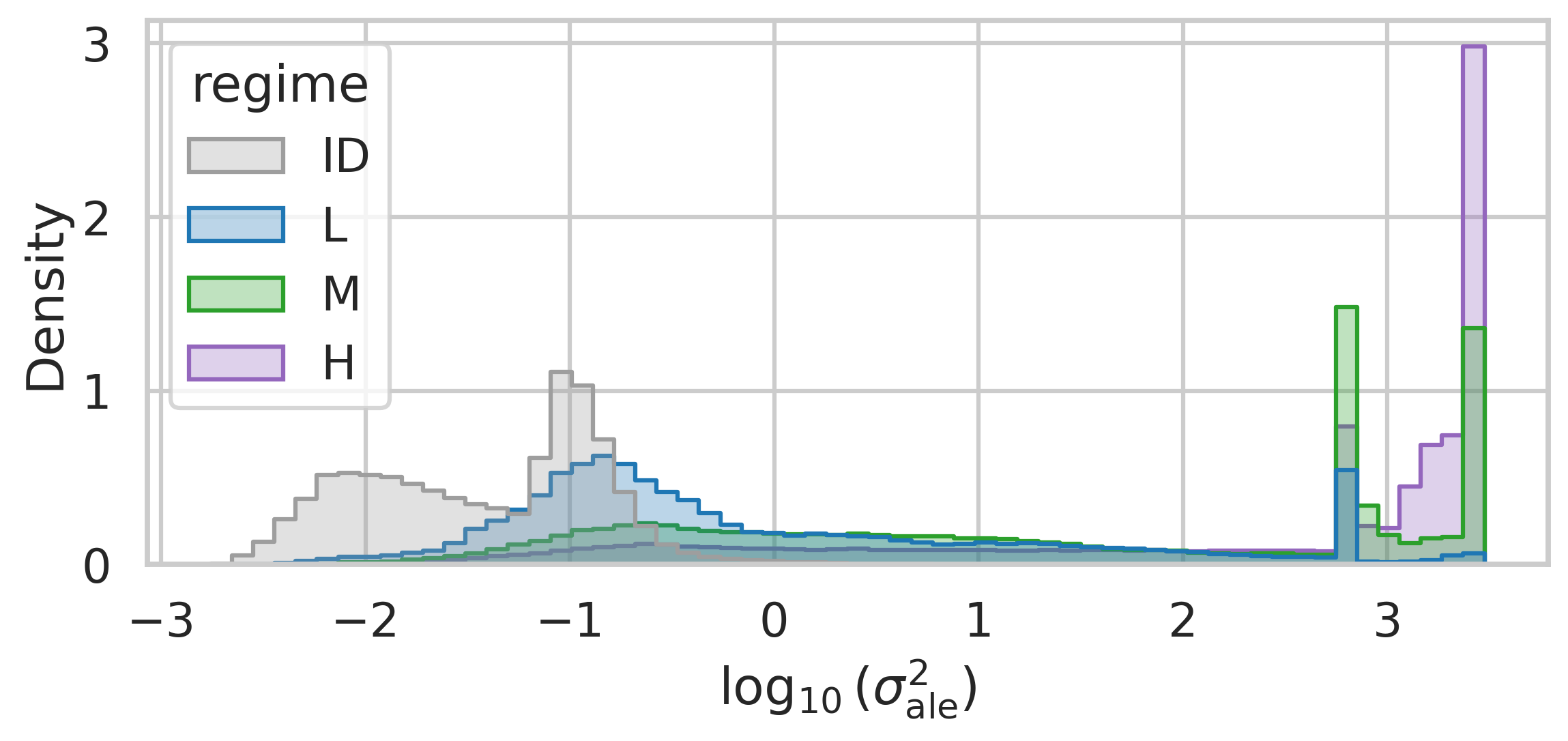
Aleatoric uncertainty increases under several structured perturbations, reflecting higher data-dependent ambiguity in the corrected residual estimate.
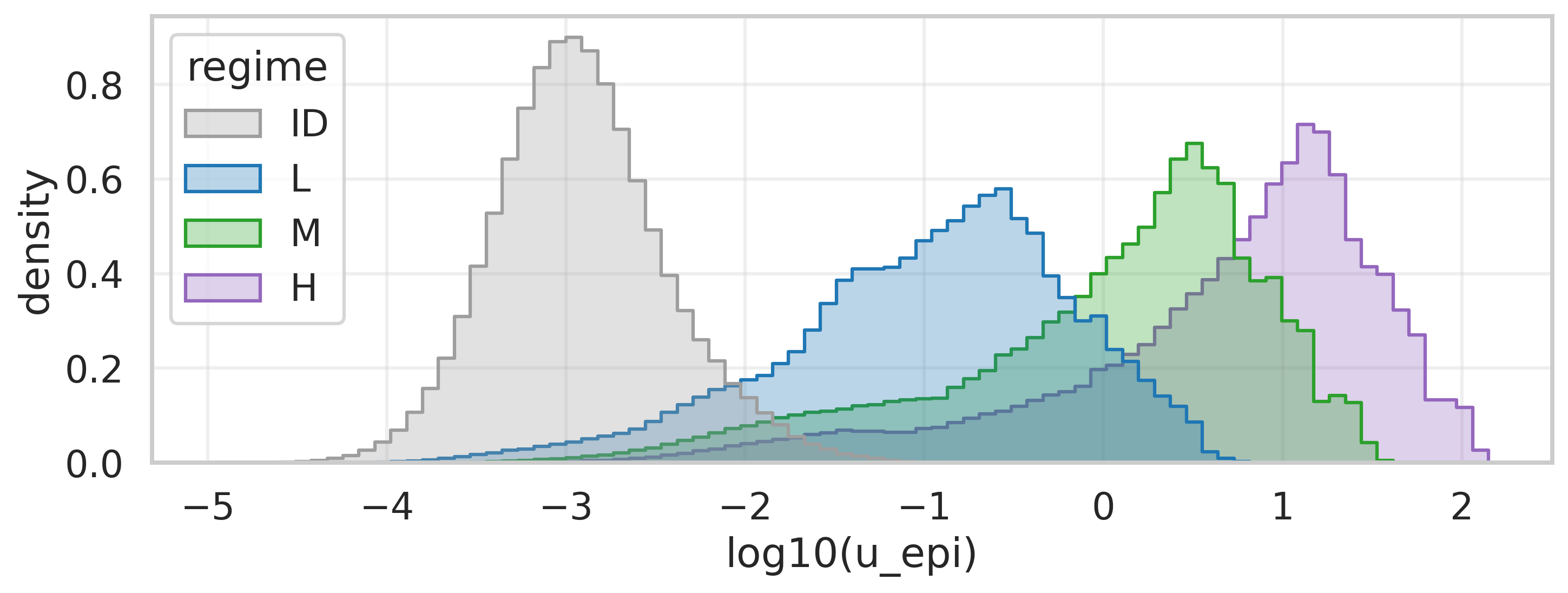
Ensemble disagreement highlights regimes where the learned correction becomes more model-sensitive under distribution shift.
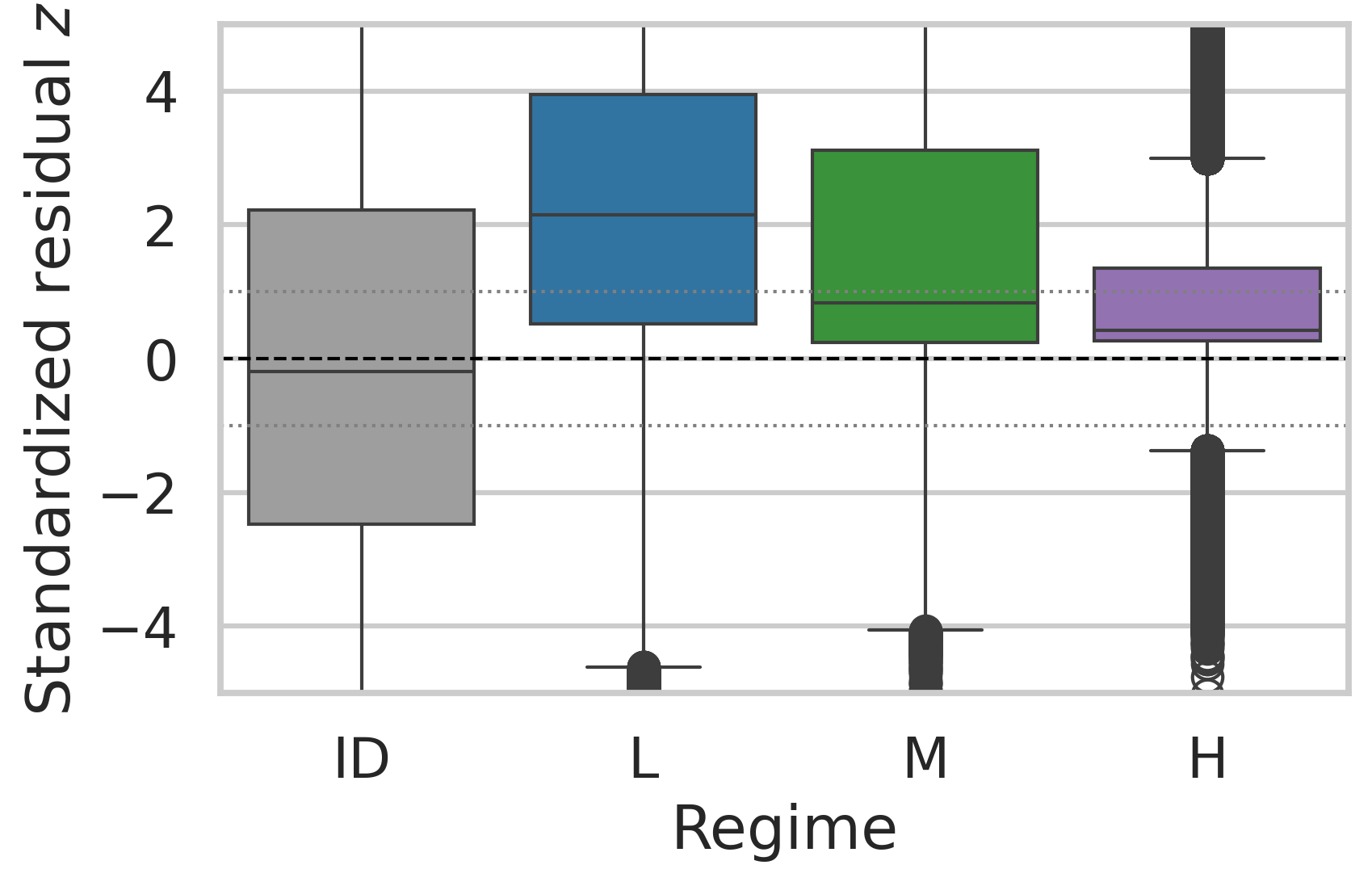
Z-score distributions show whether residual errors remain consistent with the predicted uncertainty across ID and OOD regimes.
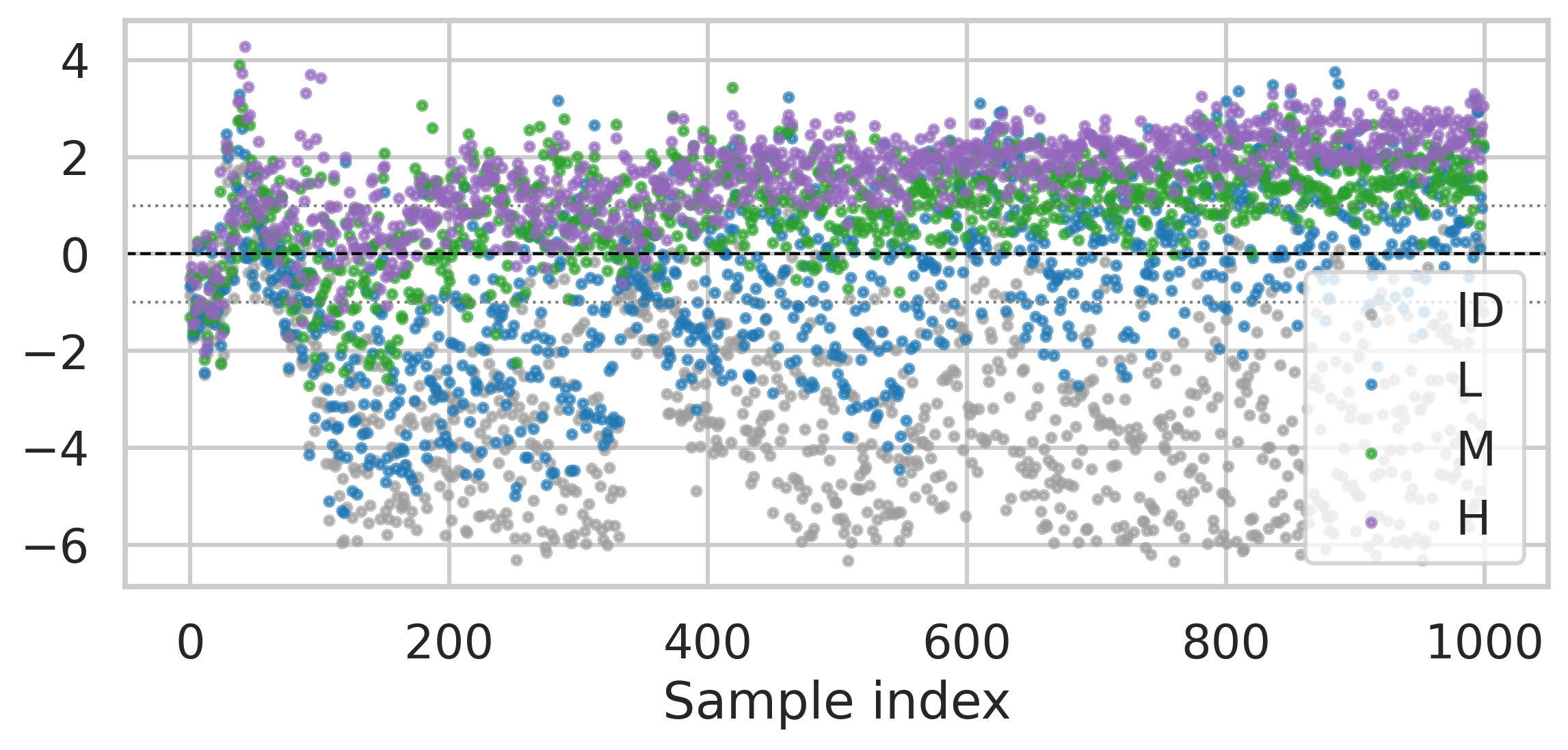
Sample-wise z-scores reveal temporal and axis-specific deviations that may be hidden in aggregate uncertainty summaries.
Attribution Behavior
Integrated Gradients are used to analyze which sensor channels and temporal regions drive both the predicted correction μ and the predicted uncertainty log σ2. The attribution maps show that correction and uncertainty are not necessarily driven by the same inputs. In several cases, the correction output relies strongly on specific gyro or star-tracker channels, while the uncertainty output shows different channel and temporal sensitivity.
Under structured perturbations, attribution patterns can remain relatively stable even when uncertainty increases. This suggests that the model may respond to OOD conditions by scaling uncertainty rather than completely changing which input features it uses.
Takeaway: attribution helps explain why uncertainty changes by revealing the sensor and temporal structures behind both correction and uncertainty estimates.
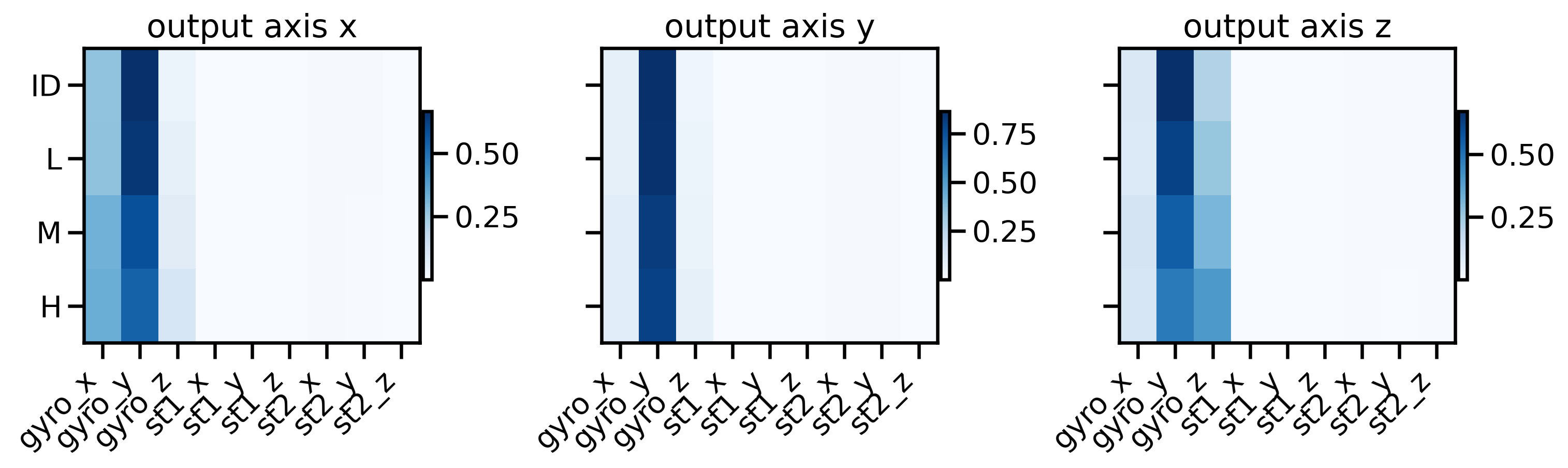
Aggregated Integrated Gradients show which gyro and star-tracker channels contribute most to the predicted residual correction, μ, across regimes.
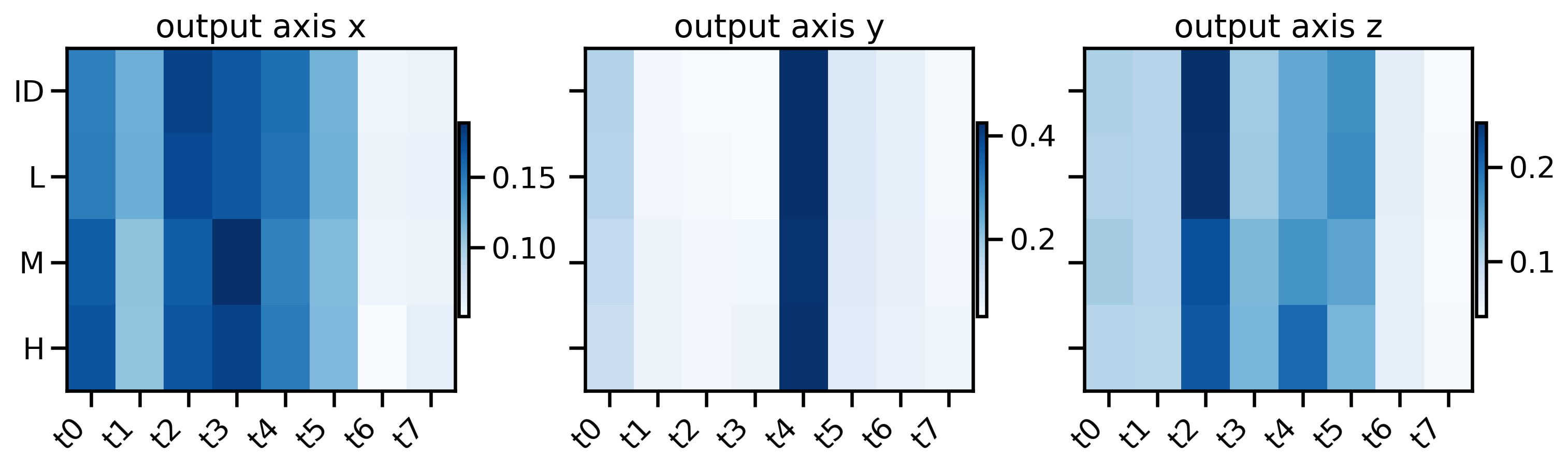
Time-wise attribution highlights which parts of the input window most influence the predicted correction, μ, revealing whether the model relies on recent samples or distributed temporal context.
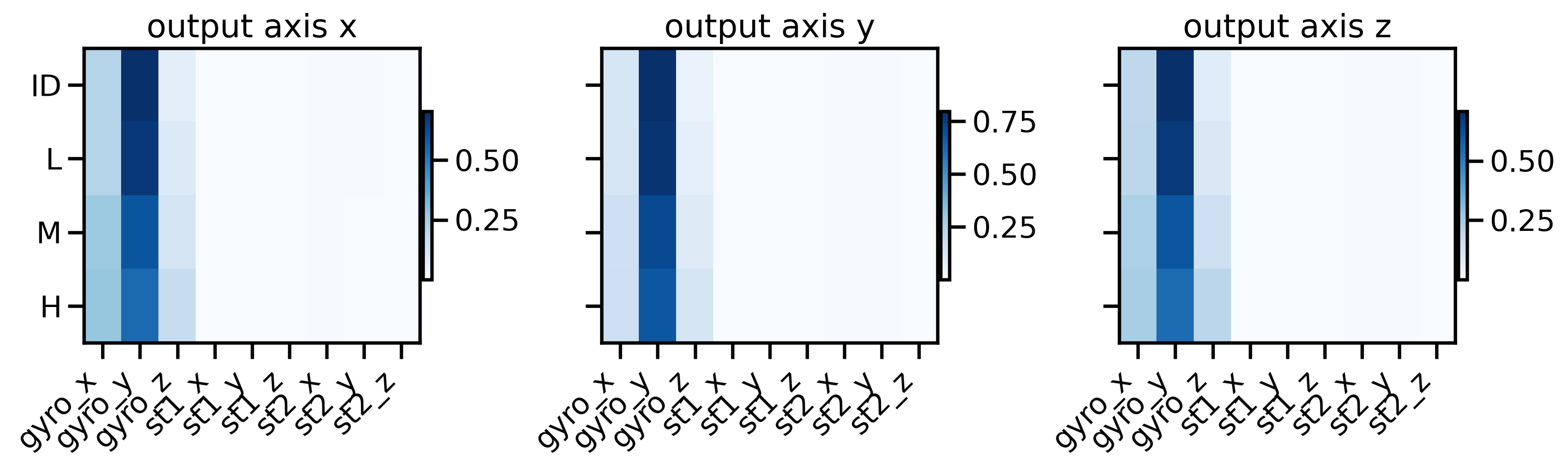
Channel-wise attribution for the aleatoric output, log σ2, shows which sensor inputs drive the predicted aleatoric uncertainty rather than the correction itself.
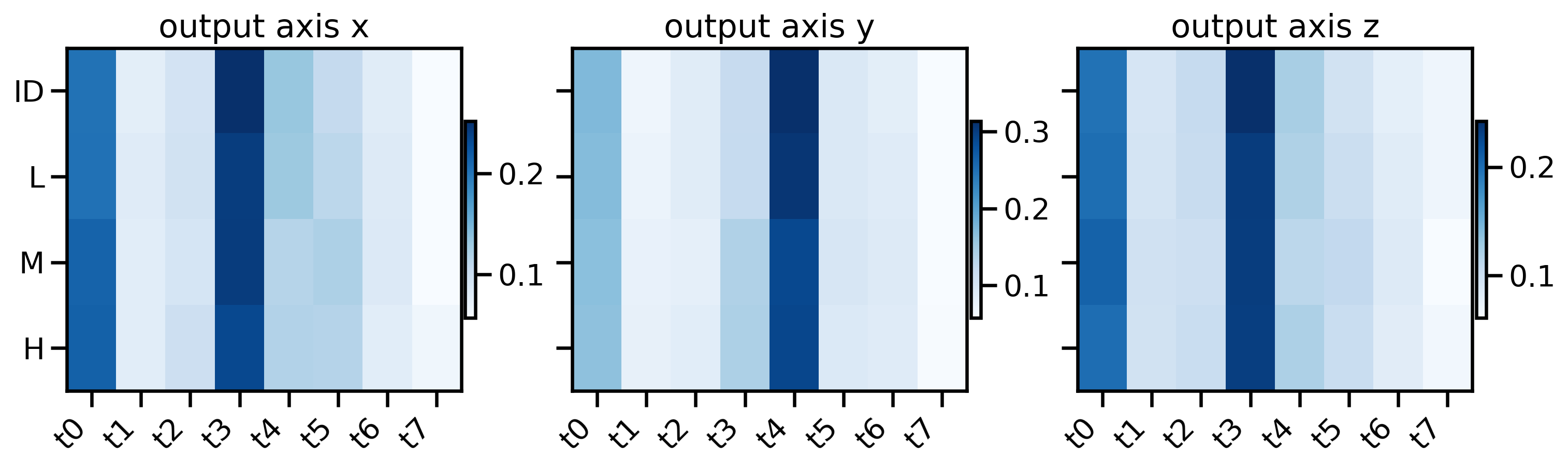
Temporal attribution for aleatoric output, log σ2, identifies when uncertainty-relevant evidence appears within the input window and whether this differs from the correction output.
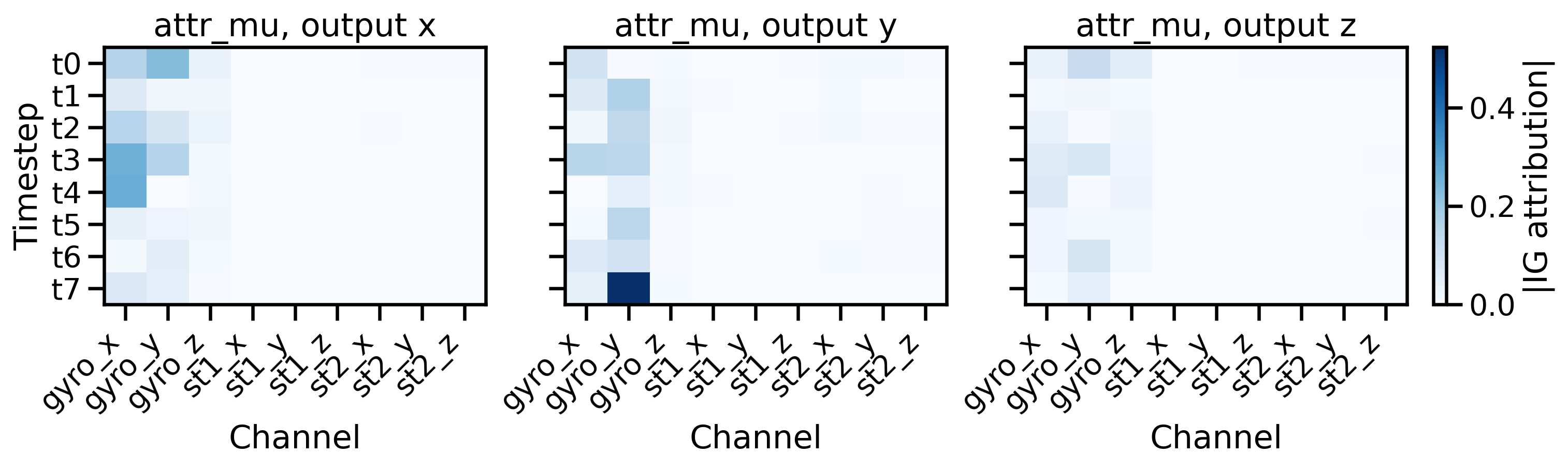
Single-window Integrated Gradients show the local sensor contributions behind one nominal correction estimate, illustrating how the aggregate attribution patterns appear at sample level.
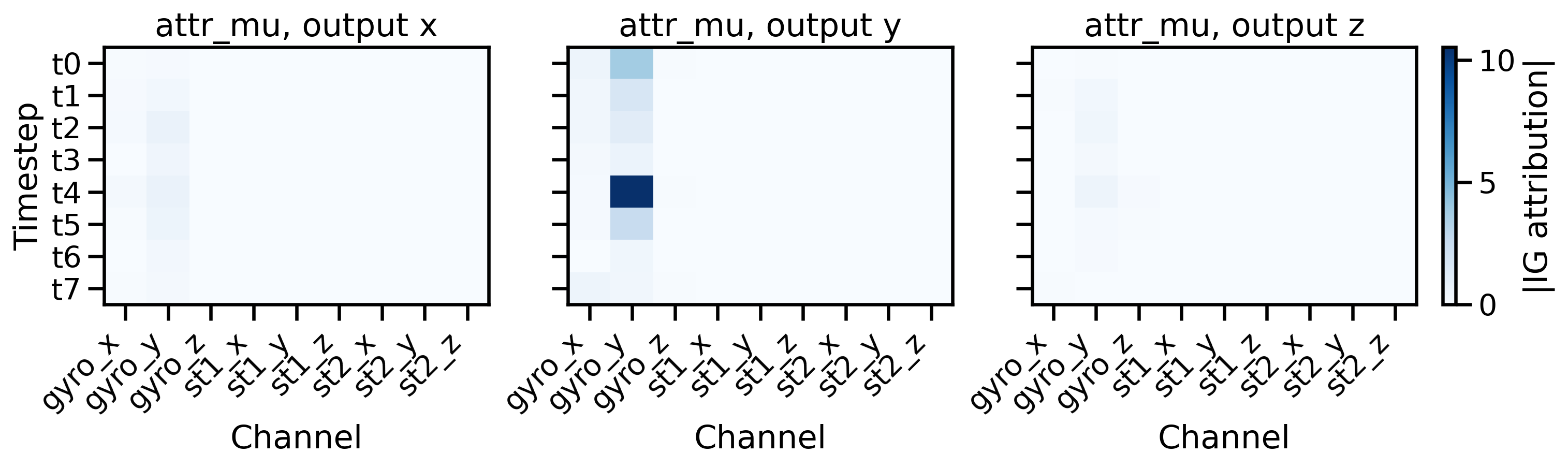
A representative OOD sample shows how local attribution changes under structured perturbation, highlighting which sensor channels and time steps dominate the correction estimate.
BibTeX
@misc{álvarez2026attributionuncertaintybehaviorlearned,
  title={Attribution and Uncertainty Behavior of Learned Residual Gyro Correction for Gyro-Stellar Estimation},
  author={Mariela De Lucas Álvarez and Melvin Laux and Arthur de Freitas Precht and Maurice Martin and Edoardo Caroselli and Frank Kirchner and Alexander Fabisch},
  year={2026},
  eprint={2607.24608},
  archivePrefix={arXiv},
  primaryClass={cs.LG},
  url={https://arxiv.org/abs/2607.24608},
}