#include <PlannerConfig.hpp>
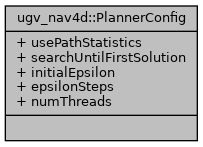
Public Attributes | |
| bool | usePathStatistics = false |
| bool | searchUntilFirstSolution = false |
| double | initialEpsilon = 20.0 |
| double | epsilonSteps = 2.0 |
| unsigned | numThreads = 1 |
| double | corridorWidth = -1.0 |
| double | maxTime = 5.0 |
| double | goalOrientationMargin = 0.0 |
| double | goalDistanceMargin = 0.0 |
| bool | useReedsSheppFinalPath = false |
| double | reedsSheppStepSize = 0.0 |
| int | reedsSheppMaxShortcut = 0 |
| bool | useReedsSheppGoalShot = false |
| double | reedsSheppGoalShotMaxDistance = 15.0 |
| int | reedsSheppMaxCusps = 1 |
Detailed Description
Describes the planner config of the path planner.
Member Data Documentation
◆ corridorWidth
| double ugv_nav4d::PlannerConfig::corridorWidth = -1.0 |
Corridor width (in meters) to constrain A* search around the 2D Dijkstra path. Set to <= 0.0 to disable corridor pruning.
◆ epsilonSteps
| double ugv_nav4d::PlannerConfig::epsilonSteps = 2.0 |
The epsilon step size for the internal ARA* algoritm. See SBPL documentation for an explantion of this value
◆ goalDistanceMargin
| double ugv_nav4d::PlannerConfig::goalDistanceMargin = 0.0 |
Margin around the goal position in meters. If the successor node's position is within this margin of the goal position, it is mapped to the goal state. Set to <= 0.0 to disable.
◆ goalOrientationMargin
| double ugv_nav4d::PlannerConfig::goalOrientationMargin = 0.0 |
Margin around the end orientation in radians. If the successor node's heading is within this margin of the goal heading, it is mapped to the goal state. Set to <= 0.0 to disable.
◆ initialEpsilon
| double ugv_nav4d::PlannerConfig::initialEpsilon = 20.0 |
The initial epsilon for the internal ARA* algorithm. See SBPL documentation for an explantion of this value
◆ maxTime
| double ugv_nav4d::PlannerConfig::maxTime = 5.0 |
Maximum processor time to use (in seconds).
◆ numThreads
| unsigned ugv_nav4d::PlannerConfig::numThreads = 1 |
Number of threads to use during planning
◆ reedsSheppGoalShotMaxDistance
| double ugv_nav4d::PlannerConfig::reedsSheppGoalShotMaxDistance = 15.0 |
Only attempt the goal shot when the (point-robot) distance to the goal is within this many meters. Keeps the shot near the goal where it pays off.
◆ reedsSheppMaxCusps
| int ugv_nav4d::PlannerConfig::reedsSheppMaxCusps = 1 |
Maximum number of direction changes (cusps) a single accepted Reeds-Shepp curve may contain. During shortcutting a direction flip relative to the previously emitted segment counts towards the budget as well, so chains of alternating short curves are suppressed too. The goal shot only offers connections within this budget. Curves over the budget are skipped; the primitive path remains as fallback so feasibility is unaffected. < 0 disables the limit (legacy behavior: any collision-free curve).
◆ reedsSheppMaxShortcut
| int ugv_nav4d::PlannerConfig::reedsSheppMaxShortcut = 0 |
Maximum number of solution waypoints a single Reeds-Shepp shortcut may span. <= 0 means unlimited (best path quality, O(n^2) shortcut search).
◆ reedsSheppStepSize
| double ugv_nav4d::PlannerConfig::reedsSheppStepSize = 0.0 |
Sampling resolution (meters) of the Reeds-Shepp final path. If <= 0.0 a value of half the grid resolution is used.
◆ searchUntilFirstSolution
| bool ugv_nav4d::PlannerConfig::searchUntilFirstSolution = false |
Search only until the first solution and then stop planning See SBPL documentation for an explantion of this value
◆ usePathStatistics
| bool ugv_nav4d::PlannerConfig::usePathStatistics = false |
Should a computationally expensive obstacle check be done to check whether the robot bounding box is in collision with obstacles. This mode is useful for highly cluttered and tight spaced environments
◆ useReedsSheppFinalPath
| bool ugv_nav4d::PlannerConfig::useReedsSheppFinalPath = false |
If true, the final path is reconstructed from the solution states using Reeds-Shepp steering (greedy shortcutting) instead of the search motion primitives. The primitive-based search itself is unchanged. Requires Mobility::minTurningRadius > 0, otherwise the primitive path is used.
◆ useReedsSheppGoalShot
| bool ugv_nav4d::PlannerConfig::useReedsSheppGoalShot = false |
Hybrid-A* style analytic goal connection: during the search, attempt to connect an expanded state directly to the goal with a single collision-free Reeds-Shepp curve. When it succeeds the search terminates immediately, skipping the expensive expansion of states around the goal heading. Requires useReedsSheppFinalPath = true (the final path reconstruction recreates the curve).
The documentation for this struct was generated from the following file: