#include <ReedsShepp.hpp>
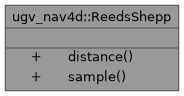
Static Public Member Functions | |
| static double | distance (double x0, double y0, double th0, double x1, double y1, double th1, double turningRadius) |
| static bool | sample (double x0, double y0, double th0, double x1, double y1, double th1, double turningRadius, double stepSize, std::vector< RSSample > &outSamples, bool forwardOnly=false) |
Detailed Description
Self-contained Reeds-Shepp steering.
Computes a path between two SE(2) poses for a car-like vehicle that can drive forward and backward and has a fixed minimum turning radius. Among all valid Reeds-Shepp words the one with the fewest direction reversals (cusps) is selected, using path length as tie-break — a reversal means stopping and switching gear, which is expensive to execute on a real vehicle, so it is prioritized over pure path length.
The implementation follows the classic Reeds & Shepp (1990) closed-form solution (48 word families grouped into CSC/CCC/CCCC/CCSC/CCSCC). It is kept dependency-free (only <cmath>/<vector>) so it can be unit tested in isolation.
Member Function Documentation
◆ distance()
|
static |
Length of the selected Reeds-Shepp path (fewest reversals, then shortest; in the same length unit as the x/y inputs, i.e. meters) between the two poses.
- Returns
- the length, or +infinity if
turningRadius<= 0.
◆ sample()
|
static |
Sample the selected Reeds-Shepp path from (x0,y0,th0) to (x1,y1,th1). Samples are spaced at approximately stepSize (meters) and always include the exact start and end pose. Each sample carries its driving direction so the caller can split the curve at cusps. If forwardOnly is set, only curves without reverse segments are considered (Dubins-style CSC words). Close pose pairs with awkward headings may then have no solution at all.
- Returns
- false if
turningRadius<= 0 or no (forward-only) curve exists.

The documentation for this class was generated from the following files:
- src/ReedsShepp.hpp
- src/ReedsShepp.cpp