pytransform3d.rotations.swing_twist_composition#
- pytransform3d.rotations.swing_twist_composition(swing, twist)[source]#
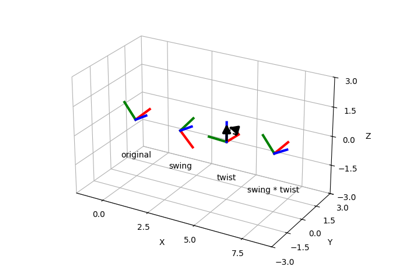
Recompose a rotation from its swing and twist components.
This is the inverse of
swing_twist_decomposition(). Given a swing and a twist quaternion, the original rotation is recovered by\[\boldsymbol{q} = \boldsymbol{q}_{swing} \boldsymbol{q}_{twist},\]i.e. the twist is applied first and then the swing.
Note that the reconstructed quaternion may differ in sign from the quaternion that was originally decomposed, since \(\boldsymbol{q}\) and \(-\boldsymbol{q}\) represent the same rotation.
- Parameters:
- swingarray-like, shape (4,)
Unit quaternion that represents the swing, a rotation about an axis orthogonal to the twist axis.
- twistarray-like, shape (4,)
Unit quaternion that represents the twist, a rotation about the twist axis.
- Returns:
- qarray, shape (4,)
Unit quaternion that represents the recomposed rotation: (w, x, y, z).
See also
swing_twist_decompositionDecomposes a rotation into swing and twist.